
10 Mistakes Students Make in CLAT PG Mock Tests (And How to Fix Them)
Giving multiple mocks and improving by 7 marks. That's what happens when you repeat the same mistakes every test. Here are the 10 that actually kill your CLAT PG score, and exactly how to fix each one.
Admin
· 19 min read
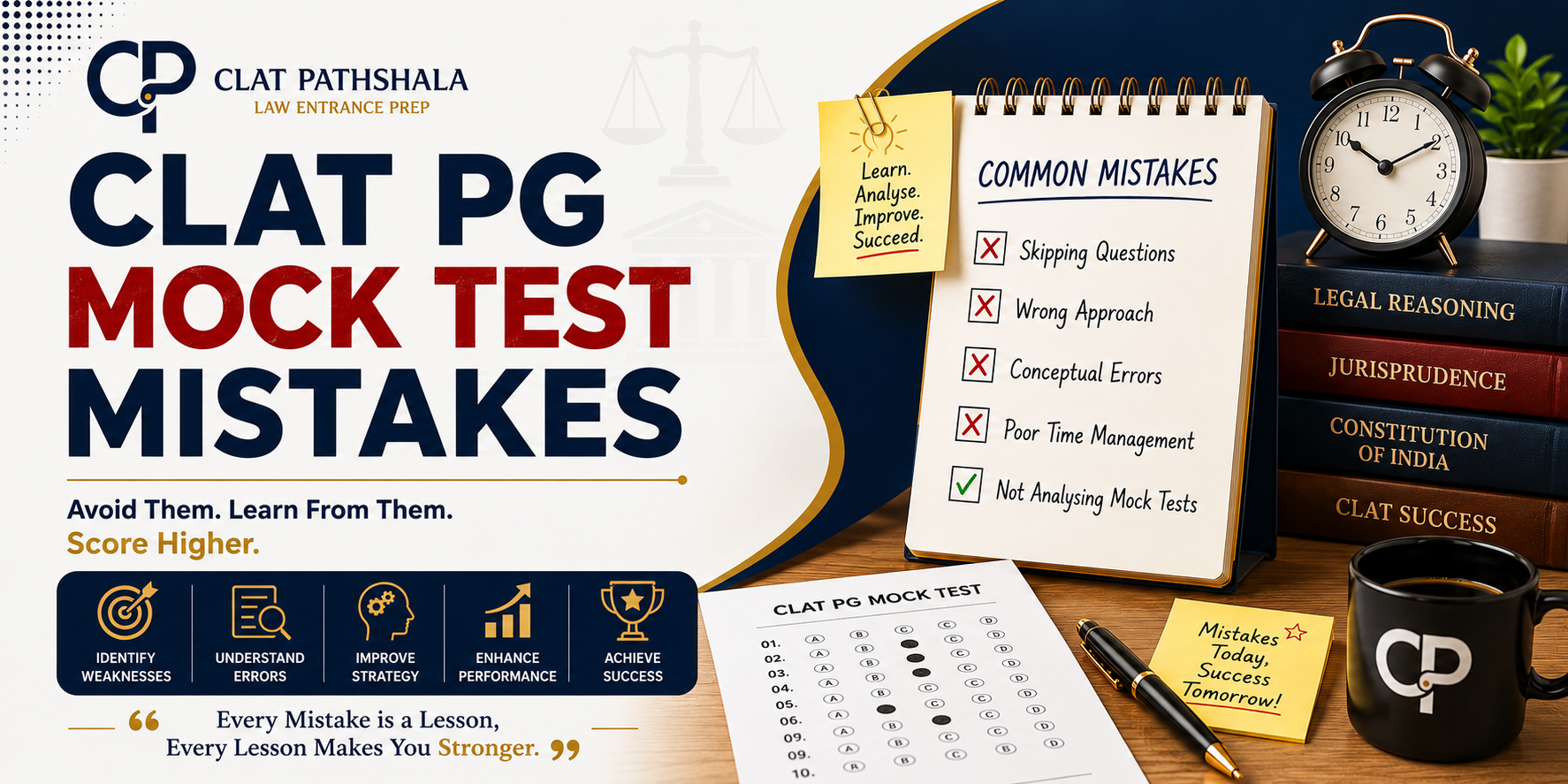
Here's something that happens more than you'd think. A student gives many CLAT PG mock tests over five months. Their first mock score was 54. Their last mock score, after all those tests and all that time, was 61.
Seven marks. In five months.
The problem wasn't effort. They showed up every day. The problem was that they gave the same test multiple times with the same habits, the same blind spots, and the same approach to reviewing it, which was basically checking the answer key, feeling bad about the wrong ones, and moving on.
If you're giving CLAT PG mocks and not improving as fast as you expected, there's a good chance one or more of the mistakes below is the reason. This isn't a generic list. Each one comes with what's actually going wrong and what to do instead.
The 10 Mistakes — and What to Do About Each One
Mistake 1: Attempting mocks before building any subject foundation
This is the most common starting mistake, and it usually happens for a reasonable-sounding reason: "I want to know where I stand before I begin."
The diagnostic mock — one single test at the start to benchmark yourself is genuinely useful. But then students get into the habit of giving mock after mock before they've actually built any knowledge in Constitutional Law, Contracts, Torts, or Criminal Law. And what they get is a very efficient system for confirming they don't know things yet.
CLAT PG is not like CLAT UG, where logical reasoning and reading comprehension can take you far even without deep preparation. The PG paper tests whether you actually know the law, the doctrine of basic structure, the rule in Rylands v Fletcher, the distinction between void and voidable contracts, and the elements of a tort. If you don't know these things going in, the mock can't teach them to you.
The fix: Take your diagnostic mock, note where you bled marks, and then go study those subjects for 4–6 weeks before your next full test. Come back to mocks once you have something to test.
Attempt Free CLAT PG Mocks at Clat Pathshala
Mistake 2: Checking the score and moving on
The score tells you almost nothing useful. 68 out of 120 does not tell you whether you got Contracts right and Constitutional Law wrong, whether you were rushing in the last 30 minutes, or whether you guessed on 15 questions and got lucky on 8 of them.
The analysis does.
And yet most students check their score, maybe glance at the wrong answers for 15 minutes, and open a new mock. This is how you give 40 mocks and improve by 8 marks.
The rule most toppers actually follow: for every 2 hours spent on the mock, spend at least 2–3 hours reviewing it. That sounds extreme. It isn't. A 2-hour mock with 3 hours of review is infinitely more valuable than three 2-hour mocks with zero review.
The fix: After every mock, go question by question through every wrong answer. For each one, write down: was it a conceptual gap, a careless mistake, or a time pressure error? That categorisation changes what you do next. (More on this below.)
Mistake 3: Treating all wrong answers the same
Picture two students who each got question 47 wrong. Student A got it wrong because they'd never heard of the principle of promissory estoppel. Student B got it wrong because they misread the question and ticked option C instead of D, they knew the answer perfectly when they went back and read it slowly.
These are completely different problems. But if you just note "Q47 wrong — Contracts" and move on, you've treated them the same way.
There are three categories of wrong answers in CLAT PG, and each one needs a different response:
Conceptual errors — you didn't know the legal principle. The fix is subject to revision, not more mocks.
Careless errors — you knew it but rushed, misread the question, or confused two options. The fix is to slow down on your next test and make a checklist of your specific careless patterns (maybe you always misread questions with "except" or "not").
Time-pressure errors — you got it right in the review but wrong in the test because you were stressed about the clock. The fix is more full-length timed practice to build stamina.
The fix: Every time you review a mock, tag each wrong answer with C (conceptual), K (careless), or T (time). After 5 mocks, count the tags. Your dominant category is your biggest problem, and now you know exactly what to do about it.
Mistake 4: Over-skipping because of negative marking fear
The -0.25 penalty scares students into skipping questions they should be attempting.
Here's the math: four wrong answers cost you one correct answer's worth of marks. So if you skip 20 questions to "play safe," you've voluntarily given up 20 marks. Yes, attempting all 20 randomly would lose you 5 marks from wrong answers — but it would also give you roughly 5 correct answers. You're not saving marks by skipping blindly; you're just avoiding one kind of loss while accepting another.
The real question isn't "should I attempt this or skip it?" The question is "how much can I narrow down the options?"
If you can get it to two options, the expected value of guessing is positive. You'll get it right roughly half the time, and the +0.5 average expected gain per question beats the -0.25 from a fully random four-option guess.
A student preparing for CLAT PG once told me she was leaving 30+ questions unattempted per mock "to protect her score." Her score was 71. When she worked on the two-option rule and started attempting the questions she could narrow down, her next mock was 84.
The fix: Never skip a question where you can rule out at least two options. Do skip questions where you genuinely have no read on any option. The line isn't "I'm not 100% sure", it's "I can't eliminate even one option logically."
Mistake 5: Changing your strategy after every single mock
Mock 3 didn't go well, so you tried a different passage order in Mock 4. Mock 4 also doesn't go well, so you change something else in mock 5. By mock 8, you've tried 6 different strategies and have no idea which one was actually best.
Strategy decisions in CLAT PG, which passage to start with, how much time to allocate per set, when to cut your losses on a hard passage, and take multiple tests to evaluate. One bad result doesn't tell you the strategy is wrong. It might tell you that that particular paper was harder, or that you were tired that day.
The fix: Pick a strategy and run it for at least 5 full mocks before changing anything. Keep notes on how it felt — not just the score, but whether you ran out of time, which passages cost you the most time, and where you felt confident. Change one variable at a time, not everything at once.
Mistake 6: Neglecting Constitutional Law because it feels overwhelming
Constitutional Law is 30–35% of the CLAT PG paper. That's somewhere between 36 and 42 questions out of 120. Students who consistently score above 85% on constitutional law passages almost always achieve a competitive rank. Students who consistently score below 60% on it rarely do — regardless of how well they do on everything else.
And yet this is the subject students most often put off. It's big. The case law is dense. Articles 12 to 35 —the directive principles, fundamental duties, federalism, emergency provisions, and constitutional amendments—it feels like too much.
Here's a specific example of how this plays out. A student who scored 79 on a CLAT PG mock reviewed his paper and found this: he got 11 out of 14 questions right in Torts, 9 out of 12 in Contracts, but only 16 out of 38 in Constitutional Law. He was performing well in every subject except the one that was 35% of the paper. His total score would have been 97 instead of 79 if he'd matched the accuracy rate of his other subjects on Constitutional Law alone.
That's not an unusual scenario. It's actually quite common.
The result is that students spend disproportionate time on Torts and Contracts (which are easier to feel "done" with), while their preparation in constitutional law remains thin.
The fix: Allocate preparation time in proportion to marks. If Constitutional Law is 30–35% of the exam, it should be 30–35% of your preparation hours. Start with the fundamental rights chapters, work through landmark cases, and get comfortable with the basic structure doctrine before worrying about Jurisprudence or IPR.
Mistake 7: Not simulating actual exam conditions
CLAT PG is an offline exam. OMR sheet, ballpoint pen, question paper, 120 minutes, a hall full of strangers, no backspace button.
Most online mock tests are convenient, but they're missing something important: they don't feel like the real thing. You can pause. You can go back. The "submit" button isn't final until you press it. The stakes feel lower because the consequences feel reversible.
And then students walk into the actual exam and find that the time pressure feels different, the anxiety feels different, and the whole experience is more disorienting than expected.
A student who cleared CLAT PG 2025 described it this way: she'd been scoring consistently around 95 on online mocks, but her hands were shaking when she filled the OMR sheet in the actual exam. She'd never practised the physical act of marking 120 circles under real-time pressure.
The fix: At least once a month, print out a mock test or get a physical copy, set a 120-minute timer, sit at a desk without your phone, and attempt it pen-on-paper. It changes the experience in ways that matter.
Mistake 8: Reattempting the same mock immediately after reviewing it
This one looks like good practice, but it's actually counterproductive.
If you get 20 questions wrong in a mock, review them, understand the correct answers, and then reattempt the same test the next day, you'll score much higher. But not because you've learned anything. You'll score higher because you remember the answers.
Reattempting a mock too soon measures memory, not understanding. And it gives you a false sense of improvement that doesn't show up on your next fresh test.
The fix: After reviewing a mock, revise the specific topics that led to your conceptual errors. Wait at least 2 weeks before reattempting that same test. By then, the memory of individual answers has faded enough that your performance reflects actual learning, not recall.
Mistake 9: Giving mocks in the final two weeks instead of revising
In the last 10–15 days before CLAT PG, many students panic and do the one thing that feels most productive: they take mock after mock after mock.
The thinking is understandable. You've been preparing all year. The exam is closed. Giving mocks feels like active preparation, like you're doing something. Sitting with a casebook or revision notes feels passive by comparison.
But here's what's actually happening. In the final two weeks, your score on a fresh mock isn't going to improve dramatically. You've already built whatever stamina and exam temperament you're going to have. What the final phase is actually for is plugging the conceptual holes you've been carrying — the constitutional law topics you've avoided, the Jurisprudence theorists you still can't distinguish, the BNS provisions you haven't mapped to the old IPC.
Mock tests cannot plug those holes. Only revision can.
Students who spend the last two weeks giving 14 fresh mocks arrive at the exam hall tired, slightly demoralised from the inevitable inconsistent scores, and still carrying the same knowledge gaps they had two weeks earlier. Students who spend that same time doing targeted revision of their weakest subjects and then take just 2–3 mocks to stay sharp arrive in a completely different state.
The fix: In the final two weeks, flip the ratio. Revise first, mock second. Pick your 3–4 weakest topics from your mock logbook and dedicate time to closing those gaps. Take one mock every 4–5 days just to stay in the rhythm — not to improve your score, but to keep the exam feeling fresh.
Use the Guide how to analyse a CLAT PG mock test and also Free CLAT PG Mock Test, at Clat Pathshala to gauge where you actually stand before deciding where to focus your revision.
Mistake 10: Preparing criminal law for an exam that no longer uses IPC
This is the most specific mistake on this list, and it's the one most students don't know they're making.
The Bharatiya Nyaya Sanhita (BNS), Bharatiya Nagarik Suraksha Sanhita (BNSS), and Bharatiya Sakshya Adhiniyam (BSA) came into force in July 2024. They replaced the Indian Penal Code, the Code of Criminal Procedure, and the Indian Evidence Act, respectively. These aren't amendments — they're entirely new statutes with new section numbers, some new definitions, and some restructured procedural rules.
CLAT PG 2027 criminal law passages will draw from the new framework. Not the IPC. Not the CrPC.
If your coaching notes still say "Section 300 IPC — Murder" and "Section 378 IPC — Theft," you're studying the wrong statute. Section 101 BNS is now murder. Section 303 BNS is theft. The numbers have changed, and some definitions have been modified.
A lot of coaching material hasn't been updated for this yet. Some popular test series are still generating criminal law passages based on IPC provisions. If your mock tests are citing IPC section numbers, that's a problem you need to be aware of.
The fix: Get your criminal law notes updated to BNS/BNSS/BSA. When attempting mock tests, check which statute the passage is drawn from. If your test series is still IPC-based, treat those criminal law passages as rough practice for reading comprehension and reasoning — but don't rely on the specific statutory references to build your knowledge.
Quick Reference: All 10 Mistakes and Fixes
| Mistake | The Fix |
|---|---|
| Mocking before building subject foundation | One diagnostic mock, then 4–6 weeks of subject study first |
| Checking score and moving on | Spend 2–3 hours reviewing every mock, question by question |
| Treating all wrong answers the same | Tag errors as Conceptual / Careless / Time-pressure |
| Over-skipping due to negative marking fear | Attempt anything you can narrow to two options |
| Changing strategy every mock | Run the same strategy for 5 full mocks before changing |
| Neglecting Constitutional Law | Allocate prep time proportional to weightage (30–35%) |
| Not simulating real exam conditions | One pen-on-paper mock per month, minimum |
| Reattempting mocks too soon | Wait 2 weeks after review before reattempting |
| Giving 14 mocks in final 2 weeks instead of revising | Flip the ratio — revise weak topics, take only 2–3 mocks to stay sharp |
| Preparing criminal law with IPC notes | Update to BNS/BNSS/BSA — the new criminal law framework |
How to Build a Mock Routine That Avoids All 10
Knowing the mistakes is one thing. Having a routine that prevents them is another.
Here's a simple structure that works for most CLAT PG aspirants:
Before the mock:
- Set a 120-minute timer and commit to not pausing it
- Keep your phone in a different room
- Have a rough sense of which subjects you're stronger in — that'll inform your passage order
- Note the date and which mock number this is in your logbook
During the mock:
- First 8–10 minutes: skim all passage headings to map the paper
- Start with passages from your strongest subjects
- On each passage: read once fully, then go to the questions
- Mark questions you're unsure about to revisit — but only return if you have time left
- Stop trying to eliminate options when you genuinely have no hook into any of them
After the mock (this is where the real work is):
- Record your score and time taken in your logbook
- Go through every wrong answer and tag it: C, K, or T (Conceptual, Careless, Time-pressure)
- For Conceptual errors: note the topic and add it to your revision list
- For Careless errors: identify the specific pattern — misread question type, confused similar options, etc.
- For Time-pressure errors: check if it's a stamina issue (happening late in the test) or a pacing issue (happening throughout)
- Write down one specific change you'll make before your next mock
The logbook entry doesn't need to be long. Date, score, dominant error type, and one action item. After 10 mocks, read back through all 10 entries. The patterns you'll see in your own writing are more useful than any coaching feedback.
One thing worth tracking separately: your per-subject accuracy
After every mock, note down roughly how many questions were from each subject and how many you got right. You don't need a spreadsheet — a rough mental count works. Constitutional Law: 38 questions, got maybe 28. Torts: 18 questions, got 14. Criminal Law: 14 questions, got 6.
That last number is the one to chase. If you're consistently getting less than 50% in a subject, no strategy change will fix that — it's a knowledge problem. But you won't notice it without tracking. Students who don't track by subject often believe they're "weak at passage reading" when they're actually just weak at Criminal Law or Jurisprudence specifically.
The fix for weak subject performance is never more mocks. It's always targeted revision followed by fresh mocks to verify the revision worked.
On comparison with others
One last thing about mock scores: stop asking your classmates what they're scoring. Some of them are telling the truth. Some aren't. Most of them are administering different tests on different platforms, with varying difficulty levels and negative-marking calibrations.
The score that matters is yours versus your own previous score. Are you scoring higher on mock 15 than on mock 5? That's the only trajectory that tells you anything real.
FAQs: CLAT PG Mock Tests 2027
Why am I not improving despite giving many CLAT PG mock tests?
Almost always, it's because the analysis isn't happening. Attempting a mock without reviewing it is like going to the gym without increasing the weight — you're putting in time, but without the feedback loop that drives adaptation. Review every wrong answer, categorize it, and change something specific before the next test.
What is the biggest mistake in CLAT PG mock tests?
Treating the score as the output. The score tells you roughly where you stand. The wrong answers tell you exactly what to fix. Students who focus on the score keep chasing a number. Students who focus on the errors keep improving.
How do I analyze a CLAT PG mock test properly?
Go question by question through every wrong answer. For each one, identify whether the error was conceptual (didn't know the law), careless (knew it but misread or rushed), or time-pressure (got it right slowly but wrong fast). Then take targeted action: revise the topic to address conceptual errors, build a checklist for careless errors, and do more timed practice to address stamina errors.
What should I do in the final two weeks before CLAT PG?
Stop adding new mocks to the pile. The final two weeks are for revision, not more testing. Go back to your mock logbook, find your 3–4 weakest topics, and spend real time on those. Take one mock every 4–5 days just to stay sharp. Students who cram 14 mocks in the final fortnight arrive tired and carrying the same knowledge gaps — students who revise arrive with those gaps closed.
How does negative marking affect my CLAT PG mock strategy?
Don't let it make you too conservative. The -0.25 penalty only hurts you on random guesses across four options. If you can eliminate two options, the math favors attempting the question. Track how many questions you skip per mock and whether your "safe" skips are actually costing you more than wrong answers would.
How many mocks should I give for CLAT PG 2027?
30–50 full-length mocks across your preparation is a reasonable target. More important than the number is the review — 30 well-reviewed mocks will do more than 80 that you glance at and discard.
Is criminal law in CLAT PG 2027 based on IPC or BNS?
BNS, BNSS, and BSA — the new framework that replaced IPC, CrPC, and the Evidence Act in July 2024. If your coaching material or test series is still referencing IPC section numbers, update your resources. This is not a minor change; the sections have been renumbered and some provisions have been rewritten.
Where to Start
If you've been giving mocks and the scores aren't moving, pick one mistake from this list — the one that sounds most like what you've been doing — and fix that first. Not all ten. One.
The logbook is probably the highest-leverage change for most people. Knowing that you'll have to write down your error category after every mock changes how you attempt it. You start paying attention differently.
And if you haven't started yet, begin with a baseline. A free CLAT PG mock test at CLAT Pathshala will show you exactly where your preparation stands right now — which subjects you're bleeding marks in, where the time pressure is hitting you, and what to fix first.
That's the starting point. Everything else follows from what the test tells you.
Related articles
Top 30 Landmark Supreme Court Judgments Every CLAT PG Student Must Know
Preparing for CLAT PG? Here are the 30 most important Supreme Court judgments you need to know, with key holdings, articles involved, and exam tips at Clat Pathshala.
Admin ·
Free CLAT PG Mock Test 2027: How to Attempt, Analyze & Score 90%+
Most CLAT PG aspirants take mock tests, check their scores, and move on. That's the wrong approach. This guide covers how to attempt, analyse, and actually improve from every mock. Plus, many free CLAT PG mock tests to start your preparation right now.
Admin ·