
CLAT 2027: Complete Guide to Eligibility, Syllabus, Pattern, Fees & Dates
Everything you need to know about CLAT 2027. The Common Law Admission Test for admission to India's National Law Universities. Check eligibility, syllabus, exam pattern, application fees, important dates and the latest updates in one place.
Admin
· 18 min read
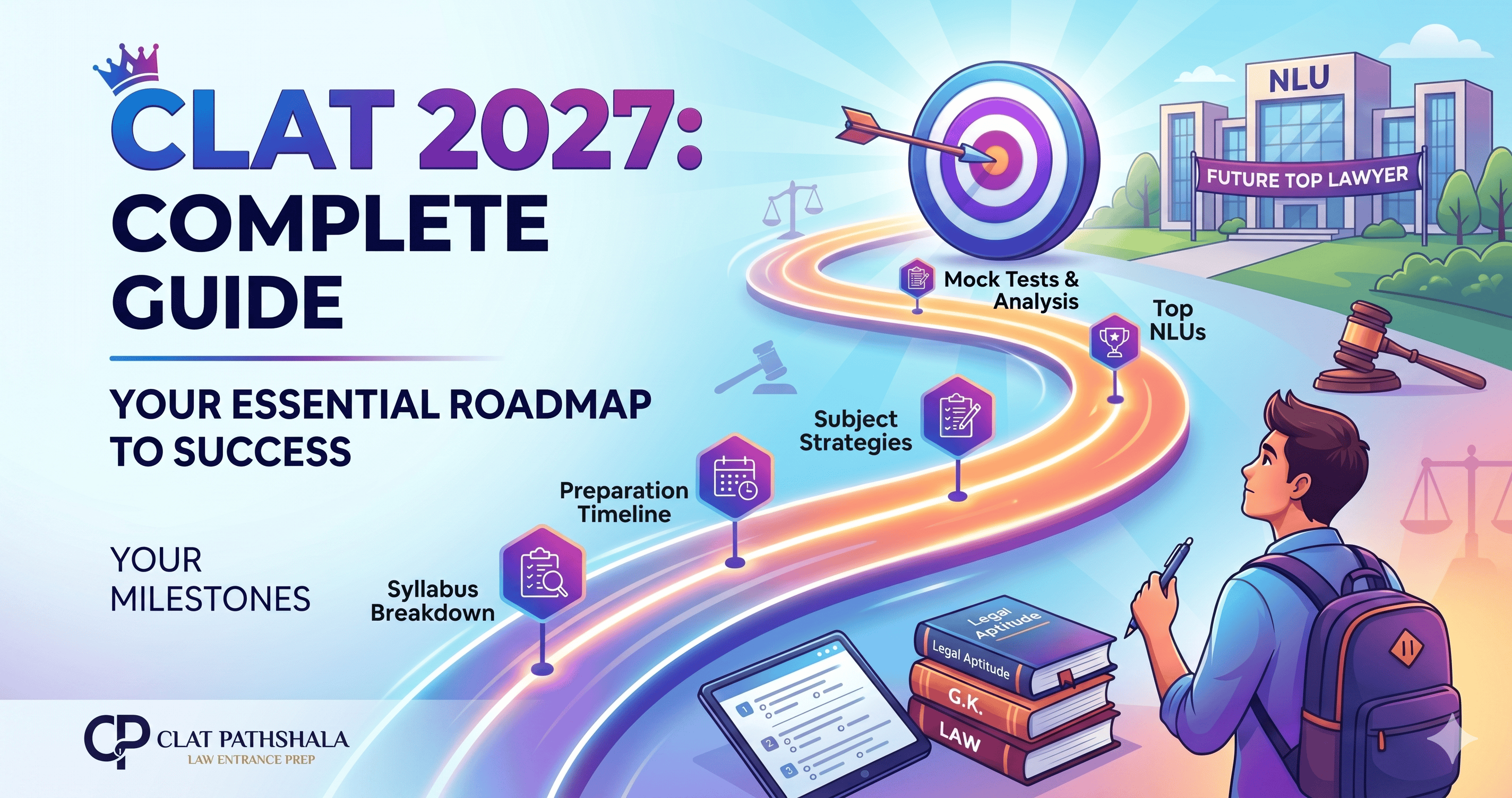
Quick answer: CLAT 2027 is the Common Law Admission Test for admission to India's National Law Universities (NLUs) in the 2027–28 academic year. It is a national-level entrance exam conducted by the Consortium of National Law Universities, expected to be held on 6 December 2026 (date tentative until the official notification). The exam is offline, lasts 2 hours, and has 120 questions. Class 12 students from any stream can apply for the undergraduate (UG) programme, and there is no upper age limit.
Here are the key facts in one place:
- Full form: Common Law Admission Test
- Conducting body: Consortium of National Law Universities (NLUs)
- Exam date (UG & PG): 6 December 2026 (expected/tentative)
- Notification: Expected in the last week of July 2026
- Mode: Offline (pen and paper, OMR sheet)
- Duration: 2 hours (120 minutes)
- Total questions: 120 (both UG and PG)
- Marking: +1 for a correct answer, −0.25 for a wrong answer
- UG eligibility: Class 12 with 45% marks (40% for SC/ST), no age limit
- Application fee: ₹4,000 (General/OBC), ₹3,500 (SC/ST/BPL)
- Official website: consortiumofnlus.ac.in
Note: CLAT 2027 happens in December 2026, not in 2027. The exam is always held in December of the year before the admission session. So if you are targeting admission in 2027, your exam is roughly six months away from this update.
What is the CLAT exam?
CLAT is a national-level law entrance exam in India. It is the single test that decides admission to the integrated five-year LLB programme (UG) and the one-year LLM programme (PG) at most National Law Universities.
The exam tests aptitude and skills rather than prior knowledge of law. A Class 12 student with no legal background can score well, because every question is based on a passage given in the paper. You read the passage and answer questions on comprehension, reasoning and general awareness. The goal is to check whether you can read carefully, reason logically and apply principles to facts, the core skills used in legal education.
The Consortium of National Law Universities conducts CLAT once a year. Before 2019, the NLUs took turns conducting the exam. Since 2019, the Consortium has run it centrally, using a single application form, a single exam, and a common counselling process for all participating NLUs.
What is the full form of CLAT?
The full form of CLAT is the Common Law Admission Test. It is called "common" because one exam is shared by many National Law Universities. Instead of writing a separate test for each NLU, you write CLAT once and use the same score to apply to all participating universities. The only major NLU that stays outside this system is National Law University, Delhi, which runs its own exam (AILET).
CLAT 2027 at a glance
| Particulars | Details |
|---|---|
| Exam name | Common Law Admission Test (CLAT) 2027 |
| Conducting body | Consortium of National Law Universities (NLUs) |
| Exam level | National |
| Courses | 5-year integrated LLB (UG) and LLM (PG) |
| Exam date | 6 December 2026 (expected) |
| Notification | Last week of July 2026 (expected) |
| Mode of exam | Offline (pen and paper) |
| Duration | 2 hours (120 minutes) |
| Number of questions | 120 (UG and PG) |
| Total marks | 120 |
| Marking scheme | +1 correct, −0.25 wrong, 0 for unattempted |
| Medium | English |
| Participating Universities | Around 27 |
| Official website | consortiumofnlus.ac.in |
What is the CLAT exam used for?
CLAT scores are used for two separate admission tracks.
The UG track is for students who have finished or are finishing Class 12 and want to study law. It leads to a five-year integrated programme such as B.A.LL.B (Hons), B.B.A.LL.B, B.Com.LL.B or B.Sc.LL.B, depending on the university. This is the route most school students take.
The PG track is for law graduates who already hold an LLB and want a master's degree. It leads to a one-year LL.M programme. The PG exam tests core law subjects studied during the LL.B, so it is very different from the UG paper in content.
Beyond the NLUs themselves, a large number of private and affiliate law colleges also accept CLAT scores for admission. So even a single CLAT attempt opens up options across dozens of institutions.
CLAT 2027 exam dates (tentative)
The Consortium had not released the official CLAT 2027 notification at the time of this update. The dates below are based on the pattern of recent years and on early communication from the Consortium. Treat them as expected, not final, and confirm everything on the official website once the notification PDF is out.
| Event | Expected date |
|---|---|
| CLAT 2027 notification released | Last week of July 2026 |
| Online registration begins | August 2026 |
| Registration closes | October/November 2026 |
| Application correction window | November 2026 |
| Admit card released | Last week of November 2026 |
| CLAT 2027 exam date | 6 December 2026 (Sunday) |
| Provisional answer key | December 2026 |
| Result declared | December 2026 |
| Counselling begins | December 2026 – January 2027 |
The exam is consistently held in the first or second week of December, which makes the timeline fairly predictable. Once the notification confirms the exam date, lock your mock-test schedule and revision plan around it.
CLAT 2027 eligibility criteria
Eligibility is one of the most searched and most misunderstood parts of CLAT. The rules are simple, but small confusions cause students to delay applying or assume they are not eligible. The criteria differ for the UG and PG programmes.
CLAT 2027 eligibility for UG (5-year LLB)
To be eligible for the undergraduate programme, you must have passed or be appearing in Class 12 (10+2) or an equivalent examination from a recognised board, with the following minimum marks:
- General / OBC / PWD / NRI / PIO / OCI / EWS: at least 45% marks
- SC / ST: at least 40% marks
A few important points:
- No age limit. There is no upper or lower age limit for CLAT UG. A student of any age can apply as long as the academic requirement is met.
- All streams are eligible. Students from Science, Commerce and Arts can all apply. Your Class 12 stream does not matter.
- Appearing students can apply. If you are giving your Class 12 board exams in 2027, you can still appear for CLAT 2027. You only need to produce proof of passing at the time of admission. If you fail to clear Class 12, the seat is forfeited.
- No limit on attempts. You can attempt CLAT as many times as you want, provided you meet the eligibility rules.
CLAT 2027 eligibility for PG (LLM)
To be eligible for the postgraduate programme, you must hold an LLB degree or an equivalent law degree from a recognised university, with the following minimum marks:
- General / OBC / NRI / PIO / OCI: at least 50% marks
- SC / ST / PWD: at least 45% marks
As with UG, there is no upper age limit, and final-year LLB students who will graduate before admission are eligible to apply. They must submit their final mark sheets and degree certificate at the time of counselling.
Eligibility quick comparison
| Criteria | CLAT UG | CLAT PG |
|---|---|---|
| Qualification | Class 12 (10+2) | LLB degree |
| Minimum marks (General/OBC) | 45% | 50% |
| Minimum marks (SC/ST) | 40% | 45% |
| Age limit | None | None |
| Appearing candidates | Eligible | Eligible |
| Stream restriction | None | Not applicable |
CLAT 2027 application fee
The Consortium has retained the application fee at the level of recent years. The figures below are expected and will be confirmed in the official notification.
| Category | Application fee (expected) |
|---|---|
| General / OBC / PWD / NRI / PIO / OCI | ₹4,000 |
| SC / ST / BPL | ₹3,500 |
The fee is paid online through credit card, debit card, UPI or net banking, and it is non-refundable. There is usually an optional charge if you want to download previous years' question papers along with your application, so read the payment page carefully before you pay.
How to apply for CLAT 2027
The CLAT 2027 application form will be available only in online mode on the official website, consortiumofnlus.ac.in. The process is straightforward.
- Register. Create an account using a valid mobile number and email ID. You will receive login credentials.
- Fill the form. Enter your personal, academic and category details exactly as they appear on your documents.
- Upload documents. Upload a recent passport-size photograph, signature and any category certificates in the format specified.
- Choose NLU preferences. Select and rank the NLUs you want to be considered for. This preference order matters during counselling.
- Pay the fee. Pay the application fee online and submit the form.
- Save a copy. Download and keep a printout of the completed form and payment receipt for your records.
Keep the following documents ready before you start:
- Class 10 mark sheet and certificate (for date of birth proof)
- Class 12 mark sheet and certificate (for UG applicants)
- LLB mark sheet and degree certificate (for PG applicants)
- Category certificate (SC/ST/OBC/EWS), if applicable
- PwD certificate, if applicable
- NRI/PIO/OCI documents, if applying under these categories
- A scanned photograph and signature in the required size
CLAT 2027 exam pattern
The exam pattern tells you how the paper is built. The number of questions, the sections, the time and the marking. The UG and PG papers share the same structure but differ in content.
CLAT 2027 UG exam pattern
The CLAT UG paper is offline and lasts two hours. It has 120 multiple-choice questions, each carrying one mark. Every question is passage-based: you are given a passage of around 450 words and then asked four to six questions on it. There is a negative marking of 0.25 marks for each wrong answer, and no penalty for questions you leave unanswered.
The number of questions was reduced from 150 to 120 a few years ago, and this format has continued. The paper is divided into five sections.
| Section | Number of questions | Approx. weightage |
|---|---|---|
| English Language | 22–26 | ~20% |
| Current Affairs including General Knowledge | 28–32 | ~25% |
| Legal Reasoning | 28–32 | ~25% |
| Logical Reasoning | 22–26 | ~20% |
| Quantitative Techniques | 10–14 | ~10% |
| Total | 120 | 100% |
Current Affairs and Legal Reasoning carry the most weight, so they deserve the most attention in your preparation. Quantitative Techniques is the smallest section, but it is also where well-prepared students pick up easy marks.
CLAT 2027 PG exam pattern
The CLAT PG paper is also offline, two hours long, and has 120 one-mark MCQs with the same +1 / −0.25 marking. The big difference is that the PG paper has no sections. All questions are drawn from core law subjects studied during the LLB, such as constitutional law, jurisprudence, contracts, torts, criminal law and family law.
The descriptive or subjective section that older PG papers once included has been removed, and the exam is now fully objective. Questions are still passage-based. You read an extract, often from a statute or a judgment, and answer questions that test your understanding of it.
| Particulars | CLAT UG | CLAT PG |
|---|---|---|
| Number of questions | 120 | 120 |
| Total marks | 120 | 120 |
| Duration | 2 hours | 2 hours |
| Sections | 5 | None |
| Question type | Passage-based MCQs | Passage-based MCQs |
| Negative marking | −0.25 | −0.25 |
CLAT 2027 syllabus
CLAT does not publish a fixed list of topics in the way a board exam does. Instead, it defines the skills each section tests. Below is what to study for each part of the UG paper, followed by the PG subjects.
CLAT 2027 UG syllabus (section-wise)
English Language. This section uses comprehension passages of about 450 words, drawn from fiction and non-fiction. You will be asked to find the main idea, draw inferences, understand the author's argument, work out the meaning of words in context, and summarise. To improve, read editorials, long-form articles and quality non-fiction regularly.
Current Affairs including General Knowledge. Questions are based on passages about news and events from the past year, covering national and international affairs, arts and culture, science and technology, sports, and legal developments. Although the passage gives context, you score faster if you already know the background, so follow a good newspaper and a monthly current-affairs compilation.
Legal Reasoning. This section gives passages on legal, moral or policy issues, along with the principles or rules that apply. You then apply those principles to a set of facts to reach an answer. You do not need prior knowledge of law — everything you need is in the passage. What you do need is the ability to read a rule carefully and apply it without adding your own assumptions.
Logical Reasoning. This section presents short passages and tests your ability to identify arguments and conclusions, spot assumptions, find analogies, recognise patterns and detect contradictions or flaws in reasoning. Practice with critical-reasoning sets builds speed here.
Quantitative Techniques. This section is built around numerical information given as graphs, tables or short passages, with questions on data interpretation and basic maths. The level is roughly Class 10. Topics include ratios and proportion, percentages, averages, algebra, mensuration and basic statistics. Revising Class 10 maths and practising data interpretation is enough.
CLAT 2027 PG syllabus
The PG paper tests the core subjects of the LLB course. The main areas are:
- Constitutional Law
- Jurisprudence
- Law of Contract
- Law of Torts
- Criminal Law
- Family Law
- Property Law
- Administrative Law
- Company Law
- Public International Law
- Intellectual Property Rights
- Environmental Law
- Labour and Industrial Law
- Tax Law
Recent judgments and important constitutional provisions tend to appear often, so keep your reading current with major Supreme Court rulings.
Participating NLUs and colleges accepting CLAT 2027
25 NLUs are expected to participate in CLAT 2027. The exact list and final seat numbers are confirmed only in the official notification and the seat matrix.
National Law University, Delhi is the one well-known NLU that does not use CLAT. It conducts its own entrance exam, AILET, for admission to its programmes. If NLU Delhi is on your wish list, you have to write AILET separately.
On seats, recent data points to roughly 3,500-plus UG seats and around 1,470-1,600 PG seats across the participating NLUs, though the figures vary by source until the matrix is published. NLSIU Bangalore offers the largest intake among the NLUs. Beyond the NLUs, 30 or more private and affiliate law colleges also accept CLAT scores, which widens your options well beyond the core list.
CLAT 2027 marking scheme and what counts as a good score
The marking scheme is simple. Every correct answer gives you +1 mark. Every wrong answer costs you 0.25 marks. Unattempted questions neither add nor subtract. Because of negative marking, blind guessing hurts you. Strong test-takers often attempt around 100 to 105 of the 120 questions with high accuracy rather than attempting all 120 with guesswork.
What counts as a "good" score depends on the NLU you are targeting and your category. As a rough guide for the General category:
- The very top NLUs, such as NLSIU Bangalore, usually need a score above 100/120, which translates to an All-India rank inside roughly the top 400–500.
- Other top-tier NLUs typically need a rank under about 1,000–1,500.
- Newer and mid-tier NLUs can be reached with ranks up to around 3,000–5,000.
The new entrant universities are likely to have the lowest cut-offs in their first year, which makes them useful "safety" options. Cut-offs also fall sharply for candidates applying under a state domicile quota at their home-state NLU.
Reservation and seat distribution
CLAT seats are split across several reservation categories. Central categories such as SC, ST, OBC and EWS apply, with EWS reservation at 10%. On top of this, most NLUs reserve a share of seats for state domicile candidates, sometimes between 25% and 50%. When a domicile quota grows, the number of All-India General seats shrinks, which raises competition for the open category. Many NLUs also keep a small number of supernumerary seats, usually 5 to 15, for NRI, NRI-sponsored and Foreign National candidates.
Because reservation and domicile rules change the real number of seats available to you, read the seat matrix in the official notification for the exact category-wise breakdown at each NLU before you finalise your preference order.
What's new in CLAT 2027
New developments stand out for the 2027 cycle.
The Consortium set up an Expert Committee, chaired by former Supreme Court judge Justice Indu Malhotra, to review and recommend reforms for both the UG and PG exams. The committee includes academics from universities such as Oxford, the London School of Economics, Columbia, Cambridge and BML Munjal University. Any change the committee recommends would be announced in the official notification, so watch for it.
How to prepare for CLAT 2027
The exam is in December 2026, so a timeline-based plan works best. From now until the notification, focus on building strong fundamentals across all five sections and on developing a daily reading habit, since reading speed and comprehension decide most of your score. Once registration opens, shift towards finishing the syllabus and taking regular sectional tests. After that, move into full-length mocks taken under exam-like conditions, and analyse every mock to find weak areas. The last two weeks before the exam should be calm and revision-focused, not a time for new topics.
A few practical habits help: read editorials and non-fiction daily for English and Current Affairs, practise legal and logical reasoning sets for accuracy, revise Class 10 maths for Quantitative Techniques, and treat accuracy as more important than the number of questions attempted.
Career scope after CLAT
A law degree from an NLU opens several paths. Graduates go into litigation as advocates, join corporate law firms, work as in-house counsel for companies, prepare for the judiciary through state judicial services, or attempt the civil services. Others move into legal research, policy work, legal journalism, or higher study through an LLM in India or abroad. The strong alumni networks of the top NLUs, which include senior judges, partners at major firms and civil servants, make these routes more accessible.
CLAT 2027 FAQs
What is the full form of CLAT? CLAT stands for the Common Law Admission Test. It is a national entrance exam for admission to law programmes at National Law Universities.
When is the CLAT 2027 exam? CLAT 2027 is expected to be held on 6 December 2026. The date is tentative until the official notification, which is expected in the last week of July 2026.
Is CLAT 2027 in 2026 or 2027? The CLAT 2027 exam is held in December 2026. It is named for the 2027–28 admission session, but the test itself takes place in the previous year.
What is the eligibility for CLAT 2027 UG? You need to have passed or be appearing in Class 12 with at least 45% marks (40% for SC/ST). There is no age limit, and students from any stream can apply.
Is there an age limit for CLAT? No. There is no upper or lower age limit for CLAT UG or PG.
How many questions are in CLAT 2027 and is there negative marking? There are 120 questions. You get +1 for each correct answer and lose 0.25 for each wrong answer. Unattempted questions carry no penalty.
What is the CLAT 2027 application fee? The expected fee is ₹4,000 for General/OBC candidates and ₹3,500 for SC/ST/BPL candidates. It is paid online and is non-refundable.
How many NLUs accept CLAT? 25 NLUs are expected to participate in CLAT 2027. NLU Delhi is the main exception, as it conducts its own exam, AILET.
Is coaching necessary to crack CLAT? Coaching can help with structure and mock tests, but it is not compulsory. Many students clear CLAT through self-study with the right material, regular mocks and disciplined reading. And this is where Clat Pathshala can help you.
Can Class 12 students apply for CLAT 2027? Yes. Students appearing in their Class 12 board exams can apply. They must submit proof of passing at the time of admission.
Final word
CLAT 2027 is the gateway to India's National Law Universities, and the structure of the exam has been stable for the past few cycles. The main things to confirm once the official notification is out are the exam date, the final list of participating NLUs, the seat matrix and any change recommended by the reform committee. Until then, you can plan your preparation confidently around the information above. Always cross-check the final dates and rules on the official Consortium website before you apply.
Official website: consortiumofnlus.ac.in
Related articles
CLAT UG Mock Test vs Full-Length Practice: Which Builds Your Rank Faster?
Most CLAT UG aspirants either give only full-length mocks or only sectional tests, and both extremes hurt your rank. Here's what actually works, when to use each, and how to build a practice schedule that moves your score.
Admin ·
Top 30 Landmark Supreme Court Judgments Every CLAT PG Student Must Know
Preparing for CLAT PG? Here are the 30 most important Supreme Court judgments you need to know, with key holdings, articles involved, and exam tips at Clat Pathshala.
Admin ·