
How to Prepare for CLAT 2027 from Zero: 6-Month Study Plan
Starting CLAT 2027 preparation from scratch? This 6-month study plan breaks down exactly what to do each month, from building a reading habit to full-length mocks, with a section-wise strategy, the best books, and a realistic daily routine to help you crack CLAT with or without coaching.
Admin
· 18 min read
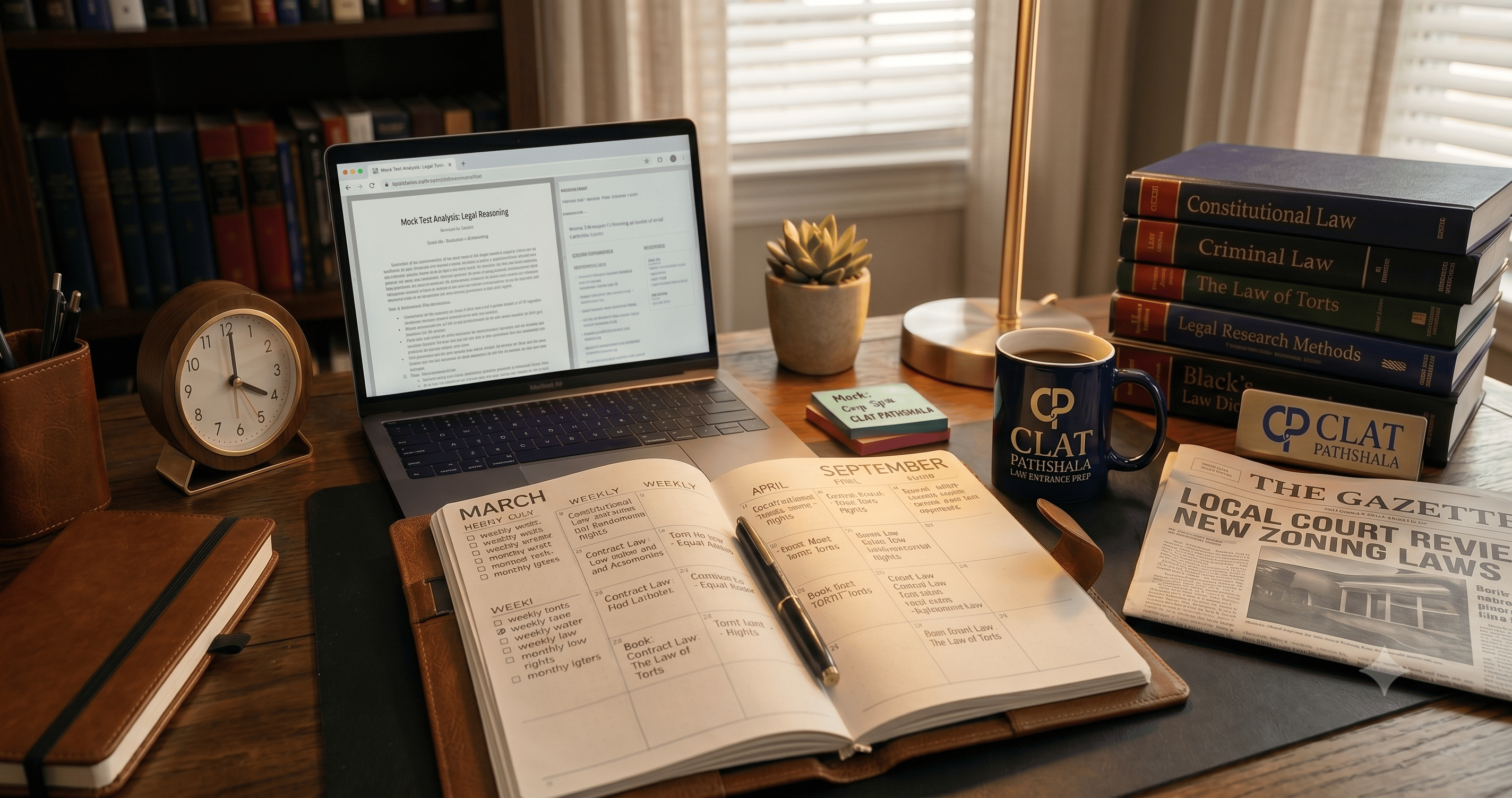
Quick answer: You can prepare for CLAT 2027 from zero in six months if you study consistently for three to five hours a day, build a daily reading habit, master one or two good books per section, and shift to full-length mock tests in the final two to three months. CLAT 2027 is expected on 6 December 2026, so a plan that starts in June 2026 gives you almost exactly six months. CLAT is not a memory test. It is a reading and reasoning-driven exam, which is why beginners with no legal background can still score well.
The five things that decide your CLAT score:
- Reading speed and comprehension —every question is based on a passage.
- Daily current affairs and newspaper reading — covers English, GK and reasoning at once.
- One or two strong books per section — not ten. Depth beats collection.
- Full-length mocks with deep analysis — this is where ranks are made.
- Consistency over six months — small daily progress beats last-month cramming.
New to the exam? Read our full CLAT 2027 guide for eligibility, syllabus, exam pattern, fees and dates before you start this plan.
Can you crack CLAT 2027 in 6 months from zero?
Yes. Six months is enough time to prepare for CLAT from scratch, and many students do exactly that. CLAT does not test how much law you know or how many facts you have memorised. It tests whether you can read a passage carefully, reason through it, and apply rules to facts. Those are skills you build with practice, not knowledge you cram.
There is one honest condition: the six months have to be consistent. Studying hard for the last four weeks does not work for CLAT, because reading speed and reasoning accuracy improve slowly and steadily. A student who reads and practises a little every day for six months will almost always beat a student who starts late and panics. If you are starting in June 2026 for the December 2026 exam, you are on time. If you start later, you can still do well, but you will need to compress the early phase and protect your mock-test months.
Understand the CLAT 2027 exam before you start
You cannot plan a route without knowing the destination, so spend your first day understanding the paper.
CLAT UG 2027 is an offline, two-hour exam with 120 multiple-choice questions, each worth one mark. There is a penalty of 0.25 marks for every wrong answer and no penalty for questions you skip. Every question sits under a passage of around 450 words. The paper has five sections.
| Section | Questions | Weightage |
|---|---|---|
| English Language | 22–26 | ~20% |
| Current Affairs including GK | 28–32 | ~25% |
| Legal Reasoning | 28–32 | ~25% |
| Logical Reasoning | 22–26 | ~20% |
| Quantitative Techniques | 10–14 | ~10% |
Two things follow directly from this table. First, Current Affairs and Legal Reasoning carry the most weight, so they get the most study time. Second, because everything is passage-based, the single skill that lifts every section is reading well and fast. That is why a reading habit sits at the centre of this plan.
The core principles of CLAT preparation
Before the month-by-month schedule, internalise five principles. They shape every decision you make over the next six months.
CLAT rewards comprehension, not memory. The 2026 paper continued the trend of longer passages and deeper inference. You score by understanding what you read, not by recalling facts. Build your study around reading and reasoning, not rote learning.
Quality of resources beats quantity. One strong book per section, used properly, is worth more than five books skimmed. Six to eight books across all sections is plenty. Collecting more material is one of the most common ways beginners waste time.
Newspaper reading is non-negotiable. Twenty to thirty minutes a day with The Hindu or The Indian Express improves your English, your current affairs, and even your legal and logical reasoning at the same time. No single habit gives a higher return.
Mocks make ranks. Reading and learning get you to the start line. Full-length mock tests, taken under timed conditions and analysed honestly, are what turn knowledge into a score. Treat mock analysis as more important than the mock itself.
Consistency beats intensity. Three to four focused hours every day for six months will take a beginner further than ten-hour days crammed into the final month. Protect your daily routine even on low-energy days.
Best books and resources for CLAT 2027
Pick one main book per section and add a practice source. Do not buy everything on this list — choose what fits and stick with it.
| Section | Recommended resources | How to use |
|---|---|---|
| English Language | Word Power Made Easy (Norman Lewis); Objective General English (S.P. Bakshi / R.S. Aggarwal); daily editorials from The Hindu or Indian Express | Build vocabulary from roots; do 20–30 minutes of editorial reading daily for inference and tone |
| Legal Reasoning | Pearson Complete CLAT Manual (By Rajneesh Singh); This is a complete guide with precise legal section; past CLAT papers (Consortium) | Practise principle–fact application sets; do not memorise law, learn to apply rules to facts |
| Logical Reasoning | A Modern Approach to Logical Reasoning (R.S. Aggarwal) for basics; CLAT-pattern critical reasoning sets | Use the basics book selectively, then move to passage-based critical reasoning quickly |
| Current Affairs & GK | Any monthly CLAT-focused current affairs compilation; Lucent's General Knowledge for static basics; The Hindu / Indian Express | Read news daily, revise a monthly compilation, keep static GK light |
| Quantitative Techniques | Quantitative Aptitude (R.S. Aggarwal); DI practice; | Revise Class 10 basics first, then drill data interpretation |
Make sure your practice material matches the current pattern. Many "topper book lists" online are outdated and still assume the old 150-question format or standalone grammar questions, which CLAT no longer uses.
The 6-month CLAT 2027 study plan (month by month)
Here is how the six months line up if you start in June 2026 for the early-December 2026 exam. The phases matter more than the exact calendar, so if your start date differs, keep the same order and compress the early months as needed.
| Month | Calendar (for Dec 2026 exam) | Main focus |
|---|---|---|
| Month 1 | June 2026 | Foundation, diagnosis, reading habit |
| Month 2 | July 2026 | Section-wise basics across all five sections |
| Month 3 | August 2026 | Concept mastery, first sectional tests |
| Month 4 | September 2026 | Full syllabus coverage, speed building |
| Month 5 | October 2026 | Full-length mocks and deep analysis |
| Month 6 | November 2026 | Revision, peak mocks, exam readiness |
Month 1 — Foundation and diagnosis
Start by understanding the exam and taking one diagnostic mock, even though you will score low. The point is to feel the paper, not to perform. Note which sections confuse you the most.
This month is about habits, not coverage. Begin reading one editorial every day and keep a vocabulary notebook for new words. Start a current affairs routine: read the news daily and note important events. Learn the basic theory of each section — what Legal Reasoning actually asks, how Logical Reasoning questions are framed, and what topics Quantitative Techniques covers. Revise Class 10 maths fundamentals so numbers stop feeling intimidating. By the end of Month 1, you should have a daily routine you can sustain and a clear sense of your weak sections.
Month 2 — Building section-wise basics
Now go section by section and build the basics. For English, continue daily editorials and start solving reading-comprehension sets. For Legal Reasoning, learn how to extract a principle from a passage and apply it to a fact situation; practise short principle–fact sets daily. For Logical Reasoning, cover the main question types — assumptions, conclusions, analogies, arrangements — using your basics book. For Quantitative Techniques, work through percentages, ratios, averages and data interpretation. Keep your current affairs notes growing.
Do not chase speed yet. This month is about understanding how each question type works and building accuracy on untimed practice.
Month 3 — Concept mastery and first sectional tests
By Month 3, the CLAT 2027 registration window is expected to open, so complete your application early and get it out of the way.
In studies, move from learning to testing. Start taking sectional tests — timed tests of a single section — to see where you stand. Aim to finish the core theory of every section this month so that the rest of your preparation is practice and revision. Keep reading daily and revise the first monthly current affairs compilation. Begin tracking your accuracy in each section; this number, more than your raw score, tells you what to fix.
Month 4 — Full syllabus coverage and speed
This is the month to close any remaining gaps and start working on speed. You should now be comfortable with every section's question types. Increase the difficulty and the volume of your sectional practice, and begin timing yourself strictly. Start taking half-length or full sectional sets back to back to build stamina.
Reading speed matters most here. CLAT gives you two hours for 120 passage-based questions, so you cannot afford to read slowly. Practise reading passages once, carefully, and answering without re-reading the whole thing. Keep current affairs revision steady so the GK section does not pile up at the end.
Month 5 — Full-length mocks and deep analysis
Month 5 is the turning point. Start taking full-length mock tests under exam-like conditions — same time of day as the real exam, no breaks, no phone. Begin with one or two mocks a week and build up.
The mock is only half the work. Spend as long analysing each mock as you spent taking it. For every wrong answer, find out whether it was a knowledge gap, a reading error, a reasoning mistake, or a careless slip, and write it down. Patterns will appear, and fixing those patterns is what raises your score. Keep revising current affairs from your compilations. By the end of this month, your scores should be climbing and stabilising.
Month 6 — Revision, peak mocks and exam readiness
The CLAT 2027 admit card is expected in late November, so keep your documents ready. In studies, this month is about peaking and tapering, not learning new things.
Take mocks at a steady pace and keep analysing them. Revise your vocabulary notebook, your formula sheet, and your full current affairs notes. Do a final consolidation of static GK and recent legal news. In the last ten to twelve days, reduce the number of new mocks, focus on revision, and protect your sleep. Walk into the exam calm and rested. A fresh mind reads faster and reasons better than a tired one.
How to prepare for each CLAT section
The plan above sets the rhythm. Here is the technique for each section.
English Language
CLAT English is fully comprehension-driven, with no standalone grammar questions. You read a passage and answer questions on the main idea, the author's tone, inferences, and the meaning of words in context. Build two skills: reading speed and vocabulary. Read editorials daily, summarise each one in two lines, and keep a notebook of new words with their meanings. Practise reading a passage once and answering, rather than going back repeatedly.
Current Affairs and General Knowledge
This section is high-scoring but volatile, and it can decide your final rank. Questions are passage-based and drawn from the past year's national and international events, plus legal news, arts, science and sports. Read a newspaper daily, maintain monthly current affairs notes, and revise them on a loop. Keep static GK light — a basic polity, history and geography refresher is enough. Do not try to memorise everything; focus on understanding important events and their context.
Legal Reasoning
You do not need prior knowledge of law for this section. CLAT gives you a passage that contains the legal principle and the factual situation. Your task is to read the passage carefully, identify the principle from within it, and then apply that principle to the facts given, without importing outside legal knowledge, personal assumptions, or moral opinions. The section is really a test of close reading and precise application. That said, in the last few years, CLAT has also shown some tendency to ask a few legal GK or current legal developments-based questions, so it is sensible to stay aware of important Supreme Court judgments, constitutional developments, and major legal news through newspapers and current affairs preparation.
Logical Reasoning
This section as well uses passages to test your ability to identify arguments and conclusions, spot assumptions, draw inferences, find analogies, and detect flaws in reasoning. The best way to prepare is to first understand the major CLAT question types and then practise them through passage-based critical reasoning sets. The biggest mistake here is overthinking. The correct answer must follow from the passage and the logic of the argument, not from outside knowledge or personal opinion. At the same time, do not ignore Analytical Reasoning (AR). It has always been part of the broader syllabus, even though many students were not preparing it seriously. CLAT 2026 did ask Analytical Reasoning questions, which makes it clear that this area cannot be neglected. So prepare Logical Reasoning with passages, but also make sure you practise standard AR sets separately and study this section seriously.
Quantitative Techniques
This is the smallest section, with only 10 to 14 questions, but it is also the most predictable, which makes it a reliable source of marks. The maths level is roughly Class 10, presented through graphs, tables and short passages. Revise percentages, ratios, averages, basic algebra and mensuration, then drill data interpretation until reading a graph is fast and automatic. Even if maths is your weak point, this section is small enough to fix with steady practice.
How to use mock tests the right way
Most students take mocks but waste them by chasing scores instead of learning from mistakes. Use this approach instead.
Take each full-length mock under real conditions: the same start time as the exam, two hours straight, no breaks, no phone, and an OMR sheet if you can manage one. After the mock, analyse every single question you got wrong and every question you guessed correctly. For each, identify the cause that is a gap in knowledge, a misread passage, a reasoning error, or carelessness and log it in a simple error notebook. After a few mocks, your most common error types will be obvious, and that is exactly what you fix next.
Track two numbers across your mocks: your accuracy (percentage of attempts that were correct) and your attempts (how many of the 120 you answered). Because of negative marking, attempting fewer questions with high accuracy usually beats attempting all 120 with guesswork. Many strong test-takers settle around 95-105 attempts at high accuracy. Find your own balance through your mocks.
A sample daily and weekly routine
A realistic plan for a school student or dropper might look like this.
On a study day of about four hours: 30 minutes reading an editorial and noting vocabulary, 30 minutes on current affairs, and then two to three hours rotating through the sections — for example, Legal Reasoning and English on one day, Logical Reasoning and Quant on the next. Keep one section as the day's main focus and one as secondary, so each section gets covered throughout the week.
Across a week: cover all five sections, take at least one sectional test (and, from Month 5, one or two full-length mocks), and keep one lighter day for revision and rest. Revise your current affairs notes every weekend so they never pile up. Build in real breaks. Six months is a long stretch, and burnout is a bigger risk than under-studying.
Common mistakes to avoid
Beginners lose more marks to process mistakes than to a lack of ability. Watch for these.
Collecting too many books and never finishing any of them. Skipping the daily newspaper because it feels slow. Starting full-length mocks too late, so there is no time to fix what they reveal. Taking mocks without analysing them. Ignoring the Quantitative section because of maths fear, when it is small and high-yield. Mugging up static GK while neglecting current affairs, which carries far more weight. Studying in long, unfocused stretches instead of consistent daily sessions. Each of these is easy to fix once you are aware of it.
Can you prepare for CLAT 2027 without coaching?
Yes. Coaching can help with structure, doubt-solving and a ready supply of mocks, but it is not compulsory. Plenty of students clear CLAT through self-study using the right books, a daily reading habit, a steady current affairs routine, and a good mock-test series. What self-study demands is discipline and honest self-analysis. If you can hold yourself to a daily routine and analyse your mocks without making excuses, you do not need a classroom. A reliable online mock-test series and a study group for discussion can cover most of what coaching offers. Clat Pathshala itsled provided free mock tests with advanvced analytics.
How many hours a day do you need for CLAT?
For a beginner over six months, three to five hours of focused study a day is a sensible target. Quality matters more than quantity. Four focused hours, with full attention and no phone, beat eight distracted hours. In the final two months, you may study a little more as mocks and analysis take up larger blocks of time, but protect your sleep and avoid long unbroken sessions that leave you drained.
CLAT 2027 preparation FAQs
Can I crack CLAT 2027 in 6 months from zero? Yes. Six months is enough to prepare from scratch if you study consistently, read daily, master a few good books, and take full-length mocks in the last two to three months.
Is 6 months enough for CLAT preparation? For most students, yes, provided the six months are consistent. CLAT tests reading and reasoning skills that improve steadily with daily practice rather than last-minute cramming.
How many hours should I study for CLAT daily? Three to five focused hours a day works well for a beginner. Consistency and full attention matter more than the total number of hours.
Can I prepare for CLAT without coaching? Yes. Many students clear CLAT through self-study using the right books, daily newspaper reading, a current affairs routine, and a good mock-test series.
Which is the most important section in CLAT? Current Affairs (including GK) and Legal Reasoning carry the highest weightage at about 25% each, so they deserve the most attention.
Do I need a legal background for CLAT? No. Legal Reasoning gives you the principle and the facts in the passage. You only need to apply the rule, not know the law beforehand.
When should I start full-length mocks for CLAT 2027? Begin full-length mocks about two to three months before the exam, which is around October 2026 for the December 2026 paper, and keep analysing each one.
How many mocks should I take for CLAT? There is no fixed number, but aim to take and fully analyse several full-length mocks across the final two to three months. Deep analysis of each mock matters more than the count.
What are the best books for CLAT 2027? Start with Word Power Made Easy for English, Pearson Complete CLAT Manual By Rajneesh Singh for legal and practice questions), R.S. Aggarwal for Logical Reasoning and Quantitative Aptitude, a monthly current affairs compilation, and past CLAT papers.
Which newspaper is best for CLAT? The Hindu and The Indian Express are the most recommended, mainly for their editorials, which build English, current affairs and reasoning together.
Final word
A six-month plan works for CLAT 2027 because the exam rewards skills that grow with daily practice. Build the reading habit early, keep your resources few and your practice deep, start mocks on time, and analyse every mistake. Confirm the official exam date and any pattern updates on the Consortium website once the notification is out, then trust your routine and keep showing up. The students who improve the most are rarely the ones who study the longest hours. They are the ones who study the same way, every day, for six months.
Official website: consortiumofnlus.ac.in
Related articles
CLAT 2027: Complete Guide to Eligibility, Syllabus, Pattern, Fees & Dates
Everything you need to know about CLAT 2027. The Common Law Admission Test for admission to India's National Law Universities. Check eligibility, syllabus, exam pattern, application fees, important dates and the latest updates in one place.
Admin ·
CLAT UG Mock Test vs Full-Length Practice: Which Builds Your Rank Faster?
Most CLAT UG aspirants either give only full-length mocks or only sectional tests, and both extremes hurt your rank. Here's what actually works, when to use each, and how to build a practice schedule that moves your score.
Admin ·