
CLAT UG Mock Test vs Full-Length Practice: Which Builds Your Rank Faster?
Most CLAT UG aspirants either give only full-length mocks or only sectional tests, and both extremes hurt your rank. Here's what actually works, when to use each, and how to build a practice schedule that moves your score.
Admin
· 18 min read
There are two types of CLAT UG aspirants who struggle in the final month.
The first type gave only sectional tests for the entire year. They could crack any English passage in isolation; they'd done hundreds of Legal Reasoning sets, and their Quant accuracy was solid. But when they sat for their first full-length mock six weeks before the exam, they ran out of time at question 80. They'd never practised the mental gear-switching that happens when you move from Legal Reasoning to Logical Reasoning to Quant in a single sitting. The exam felt completely different from anything they'd prepared for.
The second type gave a full-length mock after a full-length mock from month two. Their stamina was fine. But their Legal Reasoning accuracy was stuck at 55% for four months because they never isolated it, never understood which specific question types were bleeding marks, and never fixed the root problem. They just kept running full tests in which the problem was buried under four other sections.
Both are real patterns. And both come from treating "mock tests" as a category rather than a tool, without asking what each type of practice is actually good for.
This guide answers that. Sectional tests and full-length mocks serve different purposes, peak at different stages of preparation, and fail when you use them at the wrong time or in the wrong ratio. Here's how to use both.
What's the actual difference?
Before anything else, let's be precise about what we're comparing.
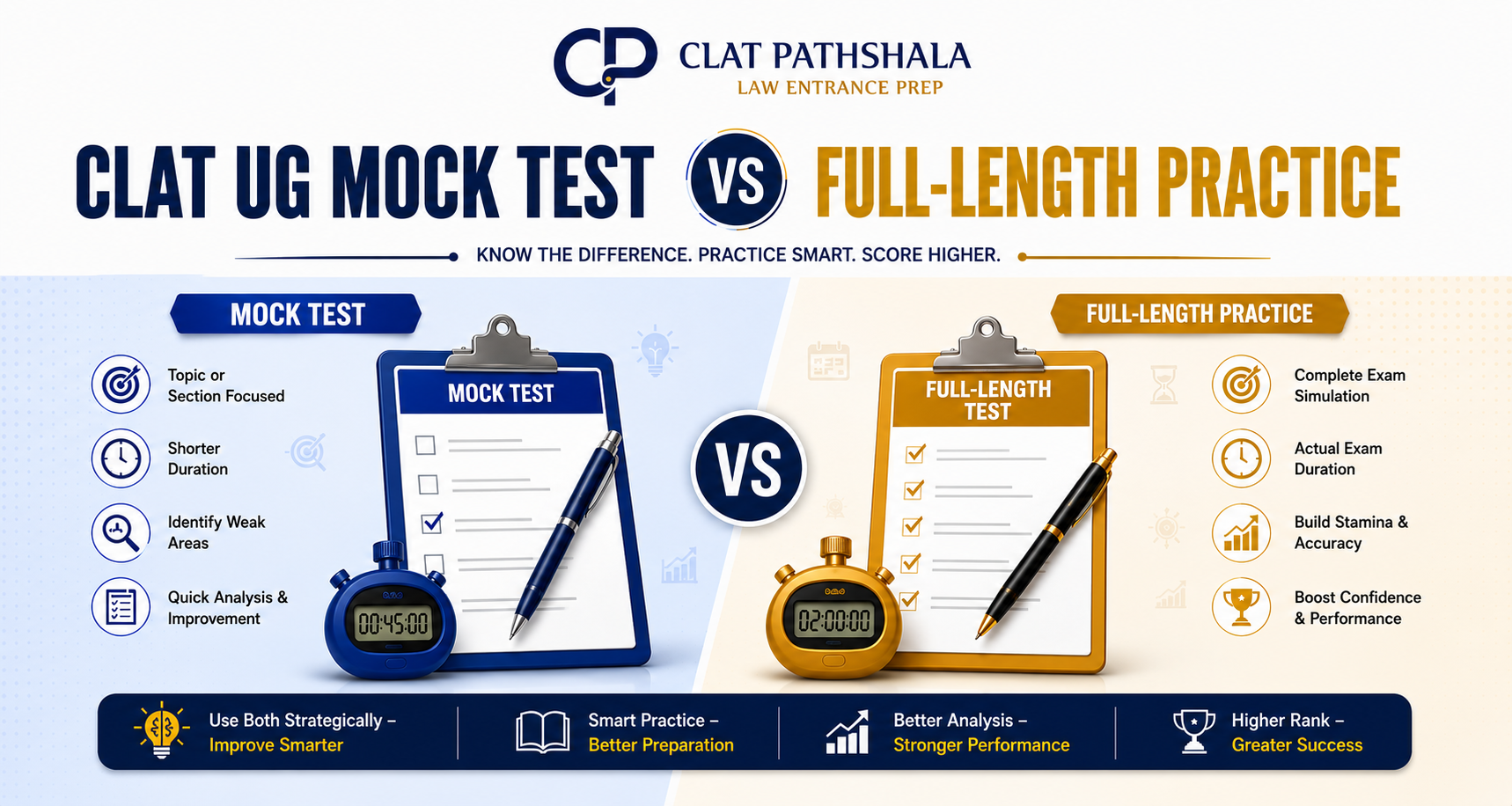
A sectional test (sometimes called a mock test in the narrower sense) covers one section at a time, just English, or just Legal Reasoning, or just Quant. It's shorter, lower pressure, and lets you focus on a single area without the noise of four other sections running simultaneously.
A full-length mock covers all five sections of CLAT UG in a single two-hour sitting: English, Current Affairs, Legal Reasoning, Logical Reasoning, and Quantitative Techniques. It's the complete exam simulation, same time limit, same format, same pressure.
| Feature | Sectional test | Full-length mock |
|---|---|---|
| Duration | 20–40 minutes typically | 120 minutes |
| Sections covered | 1 | All 5 |
| What it tests | Subject-specific accuracy | Stamina, pacing, section management |
| Pressure level | Lower | Exam-level |
| Best use | Identifying and fixing weak spots | Building exam temperament, testing overall readiness |
| When to use | Early and mid preparation | Mid and final preparation |
Neither is better than the other. They do different jobs.
What sectional tests are actually good for
Sectional tests get underrated because they feel easier. But that's the point.
The entire value of a sectional test is isolation. When you do a Legal Reasoning sectional and score 58%, you know the problem is in Legal Reasoning, the reading comprehension isn't interfering, the Quant section isn't eating your time, and your GK gaps aren't showing up in the score. The result is clean data about one specific area.
Compare that to a full-length mock where you score 72, and your Legal Reasoning accuracy was still 58%, but you don't know that because all you see is the overall number.
Sectional tests let you fix things that full-length mocks can only reveal.
Here's a concrete example of what this looks like. A student spent two months giving full-length mocks, but her GK score wouldn't move above 14/30. The full-length format meant she was revising all five sections after every mock, spreading her analysis thin. When she switched to 20-minute GK sectionals every day for three weeks — focused entirely on the types of passages she kept getting wrong — her GK accuracy went from 47% to 71%. Six weeks later, that change showed up in her full-length scores.
The section identified the problem. The sectional practice fixed it. The full-length confirmed it.
When sectionals are most useful:
Early preparation (5–6 months out) — you don't have the foundations to benefit from a full exam yet. A full-length mock before you understand how Legal Reasoning questions work is mostly just an exercise in confirming you don't know things.
After a bad full-length mock result — if you dropped marks in a specific section, go back to sectionals on that section before your next full test. Don't just keep giving full mocks, hoping the section improves on its own.
Post-revision checks — you revised Legal Reasoning for two weeks. Take a sectional to verify the revision actually worked. Don't wait for the next full mock, three weeks away.
What full-length practice is actually good for
Here's what sectional tests cannot teach you: what it feels like to be in question 90 of a two-hour exam, exhausted, with 30 questions left and only 22 minutes on the clock.
That's the experience full-length mocks build you for. Not knowledge. Stamina, pacing, and decision-making under real pressure.
The stamina problem is real.
Sustained high-quality reading for two hours is harder than it sounds. CLAT UG passages are dense, 450 words of content-heavy prose, back to back, for 120 questions. Students who've only done short sectional sets frequently find that their performance in the last 30 minutes of a full mock is significantly worse than their performance in the first 30. The concentration degrades. The reading slows. The careless errors increase.
The only way to build that two-hour stamina is to practice two-hour sessions. Regularly. Under real conditions.
The section transition problem.
This one gets almost no attention in CLAT preparation advice, and it costs students more marks than they realise.
When you move from Legal Reasoning to Logical Reasoning mid-exam, you're switching mental modes. Legal Reasoning asks you to identify a principle in a passage and apply it to a factual scenario, it's precise, rule-bound work. Logical Reasoning asks you to track arguments, identify assumptions, and detect flaws in reasoning — it's structural, inferential work. These are different cognitive gears.
Students who've only done sectional tests have always had a clean gear change with a break in between. In the actual exam, there's no break. You're on question 47 in Legal Reasoning, you turn the page, and now you're in Logical Reasoning.
Students who haven't practised this transition under timed conditions often lose 5–8 minutes just reorienting. That's 5–8 minutes you don't get back on a 120-minute exam.
The section-order strategy.
CLAT UG doesn't require you to attempt sections in any fixed order. You can start wherever you want and jump between sections. But knowing which order to attempt is a strategic decision — and you can't figure it out from sectionals.
Some students find they score better when they open with Current Affairs (lower cognitive load, builds momentum). Others prefer starting with Legal Reasoning while fresh. Still others use Quant as a palette cleanser between the heavier sections.
The right section order is personal. You find it by doing full-length mocks and tracking your energy, accuracy, and time across different sequences. You can't discover this in a 25-minute English sectional.
The time allocation math.
CLAT UG gives you 120 minutes for 120 questions across 5 sections. On paper, that's 1 minute per question. In practice, it doesn't work that way because passages take time to read, and that time is shared across the 4–6 questions under each passage.
Here's a rough time budget that works for most test-takers:
| Section | Questions | Time budget |
|---|---|---|
| English Language | 22–26 | 22–25 mins |
| Current Affairs | 28–32 | 25–28 mins |
| Legal Reasoning | 28–32 | 28–30 mins |
| Logical Reasoning | 22–26 | 22–25 mins |
| Quantitative Techniques | 10–14 | 12–15 mins |
That adds up to around 109–123 minutes — tight, but workable if you're disciplined. The danger zone is Legal Reasoning, which tends to pull students in. One difficult passage on fundamental rights or contract interpretation can eat 10–12 minutes on its own if you let it. Students who haven't practised pacing in full mocks find this out the hard way — usually at question 85 with 18 minutes left.
The other thing full-length practice teaches you is when to cut your losses. Every CLAT paper has two or three passages that are unusually dense or drawn from an unfamiliar subject area. Students who've done extensive full-length mocks develop a feel for this — they spend 90 seconds on a passage, realise it's going to cost them disproportionate time, mark it, and move on. Students who've only done sectionals have never had to make that call under real pressure.
Full-length mocks also reveal your hidden strengths.
Most students track only where they're losing marks. But full-length analysis sometimes shows you that a section you thought was weak is actually your most consistent performer under pressure — and that changes your section-order strategy. Some students discover they're actually faster and more accurate on Logical Reasoning than on English when they're midway through an exam, because the shorter passages suit them better when they're tiring. You only find this out from full exam data.
CLAT Pathshala's analytics across test-takers consistently show that students whose full-length mock scores stabilise in the 90–100 range in the 6 weeks before the exam almost always land in the same range on the actual paper. Sectional scores don't have that predictive value — they can look strong even while the full-exam experience remains fragile.
The verdict: which builds your rank faster, and when
The honest answer is: it depends entirely on where you are in preparation. Both tools are essential. Used at the wrong phase, both can slow you down.
Here's the phase-wise breakdown:
| Phase | When | Ratio | Focus |
|---|---|---|---|
| Foundation phase | 5–6 months out | 90% sectional, 10% full-length | Build section-specific accuracy; one diagnostic full mock to benchmark |
| Building phase | 3–4 months out | 60% sectional, 40% full-length | Start mixing in full mocks; continue fixing sectional weaknesses |
| Peak phase | Final 2 months | 30% sectional, 70% full-length | Full mocks 2–3 times per week; sectionals only for targeted revision |
| Final 2 weeks | Last 2 weeks | 10% sectional, 90% full-length | 1 full mock every 2–3 days; mostly revision, not new tests |
A few things to note about this schedule.
The diagnostic full-length in Month 1 is intentional. You should give one full mock before you've studied properly — not to perform well, but to see your baseline. Where do you bleed marks? Which section feels most foreign? If you've never looked at a CLAT UG paper before, the CLAT 2027 exam pattern and syllabus is worth reading before this first test, so the format isn't a complete surprise.
The final two weeks are not the time to add new mocks. This is a common mistake — students panic and give 10 mocks in the last fortnight, arriving at the exam hall tired. One full mock every 2–3 days keeps you sharp without burning you out.
How to actually run a full-length mock (most students do this wrong)
Giving a full-length mock is not just opening a test on your laptop and clicking start. How you set it up changes what you get out of it.
Before the mock:
Set it up at the same time of day as the actual CLAT exam — currently expected around 2 PM. Your energy levels, focus, and reading speed vary throughout the day, and you want your brain calibrated to perform at exam time, not at 9 AM when you're fresh or at 11 PM when you're winding down.
Keep your phone in a different room. Not face down on the desk — actually away. The willpower cost of not checking it mid-mock is a real cognitive drain, and in the exam hall, it simply won't be there.
If you can manage a pen-on-paper setup at least once a month, printing the mock or working from a physical question set, do it. CLAT is an offline exam. The act of marking an OMR sheet, the physical fatigue of writing for two hours, the inability to "go back" the way you can on a digital platform — these are small but real differences that show up in actual exam performance if you've never practised them.
During the mock:
Commit to zero pauses. No stretching breaks, no water breaks that turn into five-minute phone checks. Two hours straight. If you need water, put it on the desk before you start.
Keep a rough time check every 30 minutes. Not constantly, that's distracting, but a glance at the 30, 60, and 90-minute marks to confirm you're roughly on pace. If you're 15 minutes behind pace at the 60-minute mark, you need to adjust. You won't know how to adjust if you're not checking.
After the mock:
Wait 30 minutes before reviewing. Let the exam pressure subside so you can review with a clear head, not with the emotional residue of the questions that stressed you out.
Then go question by question. Not section by section or question by question. For each wrong answer, write down the reason: knowledge gap, misread passage, reasoning error, or careless mistake. For each correct answer that you guessed or were uncertain about, note it. Lucky correct answers are almost as informative as wrong ones — they tell you where your knowledge is shaky even when it works out.
The review should take at least as long as the mock. Often longer.
Here's what trips up both approaches: most students take the test, check the score, and move on. That's true for sectionals and full-lengths equally.
The score is almost useless. 68/120 on a full mock tells you nothing actionable. 17/28 on a Legal Reasoning sectional tells you almost nothing actionable. What matters is understanding why each wrong answer was wrong — and that requires sitting down with every incorrect response and categorising it.
For sectional test analysis:
Don't just note "got it wrong." Ask: Was this wrong because I didn't understand the legal principle in the passage, or because I applied it incorrectly to the facts, or because I misread the question? These are three completely different problems. The first is a comprehension issue. The second is a reasoning issue. The third is a carelessness issue. Each needs a different fix.
Track your error type across 5–6 sectionals in the same subject. If 70% of your Legal Reasoning errors are "applied the principle incorrectly," the fix isn't more passages — it's slowing down and being more precise about how rules interact with facts.
Track your attempts vs accuracy across mocks — this number tells you more than your score.
CLAT's -0.25 negative marking means the right strategy isn't always to attempt every question. Most students find a natural sweet spot somewhere between 95 and 110 attempts out of 120, with high accuracy on what they do attempt. Getting to your personal sweet spot takes full-length mock data.
Here's why sectionals can't tell you this. In a 25-minute Legal Reasoning sectional, you naturally attempt everything, there's no time pressure forcing you to choose between attempting or skipping. In a full-length mock, with 30 minutes left and 35 questions to go, you're making real skip/attempt decisions. Students who haven't trained this skill under pressure often either over-skip (too conservative, leaving 20 questions blank) or over-attempt (guessing randomly, costing themselves marks on negative marking).
Track two numbers after every full mock: your attempts and your accuracy percentage on attempts. If attempts are going up but accuracy is dropping, you're pushing into guessing territory. If accuracy is high but you're leaving 25+ questions untouched, you might be over-skipping. Your goal is to find the combination that maximises your raw score given your accuracy level, and that combination is personal. Only full-length data tells you what it is.
Track two numbers that most students ignore: your per-section time and your per section accuracy. Not just overall. After every full mock, note: how long did you spend on each section, and what was your accuracy in each?
Patterns that only appear in full-length data: you spend 32 minutes on Legal Reasoning (4 minutes over target), which means every other section is compressed. You're accurate in English when it's first, but accurate in Logical Reasoning when you attempt it later — maybe because you warm up through reading. Your Quant accuracy drops from 75% to 45% when you're doing it in the last 20 minutes — a stamina issue, not a knowledge issue.
None of this shows up in sectional scores. It only appears when you're viewing the entire paper as a single connected session.
If you're building your preparation around a structured study plan — month-by-month, section by section — the analysis framework for both test types fits directly into what a systematic CLAT 2027 preparation plan builds toward. The mocks don't exist in isolation; they're feedback loops for the study work happening in between.
The one thing that kills both approaches
Whether you're doing sectionals or full-lengths, the single biggest waste of time is giving tests without analysing them.
A student who gives 3 full-length mocks per week, checks the score, and moves on is accumulating fatigue and not much else. A student who gives 1 full-length mock per week, spends three hours reviewing every wrong answer, categorises errors, and changes something specific before the next test will improve faster every single time.
The test is the question. The analysis is the answer.
This applies to sectionals, too. A 25-minute Legal Reasoning sectional with 30 minutes of honest analysis is more valuable than three sectionals with no analysis. You're not training your brain by doing questions — you're training it by understanding why you get things wrong and doing the work to stop repeating it.
Build a simple error log. After every test — sectional or full-length — write down: the section, the error type (conceptual/careless / time-pressure), and one specific fix. After 10 tests, read through the log again. The recurring patterns will be obvious, and those patterns are your actual preparation priorities.
FAQs: CLAT UG sectional tests vs full-length mocks
Should I do sectional tests or full-length mocks for CLAT UG 2027?
Both, in different proportions at different phases. Sectionals are better early — they isolate weaknesses and let you fix specific problems. Full-lengths are better later, they build stamina, section management, and exam temperament. Using only one throughout is the mistake.
When should I start full-length mocks for CLAT UG 2027?
Start with one full-length diagnostic mock right at the beginning, then shift to regular full-length mocks starting about 3 months before the exam (October 2026 for December 2026). Going earlier is fine if your section-wise foundations are reasonably solid. Going later means you don't have enough time to learn from them.
How many full-length mocks should I give for CLAT UG?
There's no magic number. 15–25 full-length mocks across the final 3 months, each properly analysed, is a solid target. 40 mocks with no analysis is worse than 15 with deep review.
What is the difference between sectional and full-length CLAT practice?
Sectional tests cover one section at a time and help you identify and fix subject-specific problems. Full-length mocks simulate the complete two-hour exam and help you build stamina, pacing, section-order strategy, and overall readiness. They're not substitutes for each other, they do different jobs.
Is sectional practice enough for CLAT UG or do I need full tests?
Sectional practice alone is not enough. It leaves you unprepared for the section-transition problem, the two-hour stamina requirement, and the time-allocation decisions that only appear in a full exam. You need both, in the right ratio at the right phase.
My full-length scores are not improving despite giving many mocks. What's wrong?
Almost always, the analysis isn't happening. Giving a mock and checking the score is not preparation. Review every wrong answer, categorise the error, and change something specific before the next mock. Also, check: are you spending enough time on sectional practice for your weak areas? Full-length scores won't improve if the underlying section-specific problems haven't been fixed.
The bottom line
Sectional tests are diagnostic and corrective; they show you what's wrong and let you fix it cleanly, one section at a time. Full-length mocks are developmental and predictive — they build the exam experience itself and give you the most accurate picture of where your rank will land.
The students who rank well at CLAT UG aren't the ones who gave the most mocks. They're the ones who used the right type of practice at the right time, analysed every test honestly, and made specific changes based on what they found.
That's the whole thing. Start sectionals early, introduce full-lengths from 3 months out, analyse everything, and keep adjusting. The preparation does the rest.
Related articles
How to Prepare for CLAT 2027 from Zero: 6-Month Study Plan
Starting CLAT 2027 preparation from scratch? This 6-month study plan breaks down exactly what to do each month, from building a reading habit to full-length mocks, with a section-wise strategy, the best books, and a realistic daily routine to help you crack CLAT with or without coaching.
Admin ·
Top 30 Landmark Supreme Court Judgments Every CLAT PG Student Must Know
Preparing for CLAT PG? Here are the 30 most important Supreme Court judgments you need to know, with key holdings, articles involved, and exam tips at Clat Pathshala.
Admin ·